The Familiar Composer Is Not a Listening Plan
A familiar composer is not a listening plan. Follow one recurring rhythm or texture change to give an unfamiliar concert piece a clear thread.
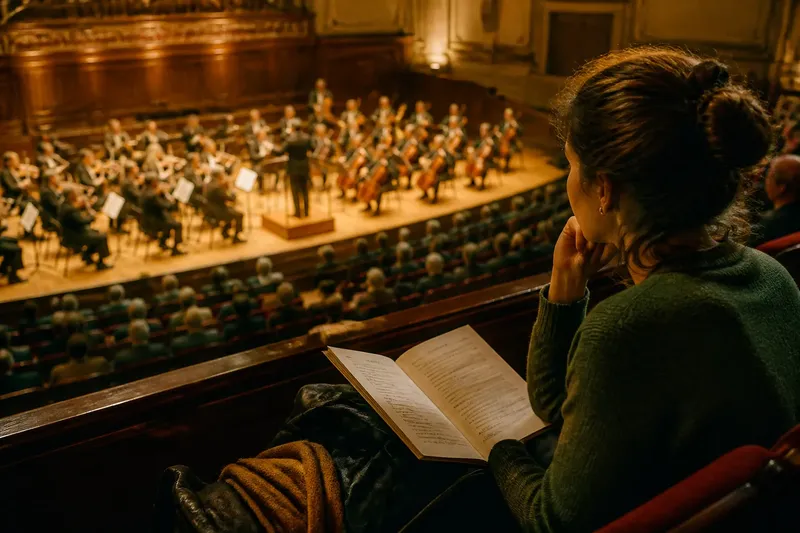
You recognise the composer’s name on the concert programme, and a few familiar sounds come to mind as you settle into your seat. Then the music begins, turns somewhere you did not expect, and the name offers little help with what to listen for next. A familiar composer is not a listening plan. One small feature—a recurring rhythm, a change in texture, a phrase passed between instruments—can give your attention a steadier thread.
Imagine Maya, an invented concertgoer, has chosen an evening programme because one composer on it is familiar from music she has heard before. She does not want to study the score or memorise a guide. She wants to listen with curiosity rather than spend the performance checking whether each passage matches what she expects. Her starting point is simple: she knows the name, but not the particular piece.
A composer’s name creates expectations, not a map
A composer’s name can bring a mood, a remembered melody or a broad impression. Those associations are a doorway, but not a map of the piece in front of you. Even music by a familiar composer may use a sound world, pace or ensemble unlike the work you remember.
Maya notices that she has been imagining a flowing melody. If she listens only for that, she may miss a passage built around short, repeated notes, or a quiet line that gradually gathers weight. She is not wrong to expect echoes of music she knows; the trouble begins if those echoes become the only thing she is prepared to hear.
It helps to separate recognition from attention. Recognition says, “I know this name.” Attention asks, “What is happening in this passage, and what might return?” The second question works even when the music surprises you. You can notice a pattern without identifying its formal name or explaining what the composer intended.
Choose one audible feature before the music begins
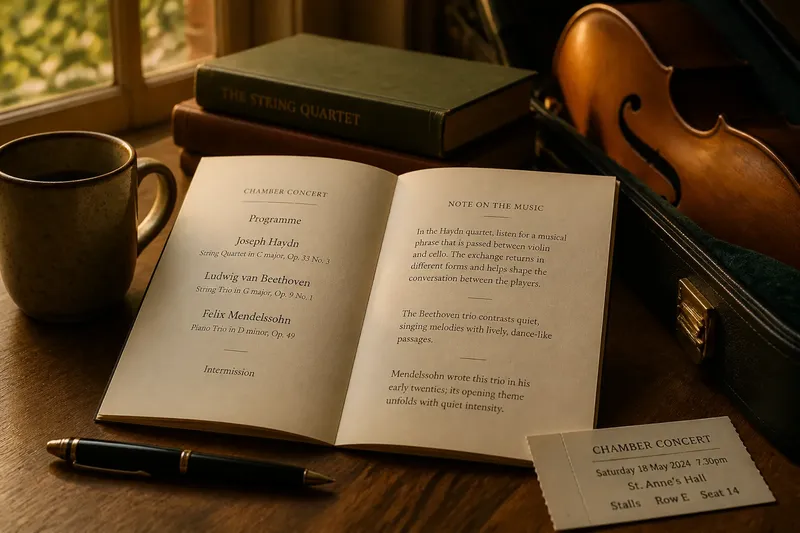
Looking at the programme, Maya finds the title of the piece and its instrumentation. She does not treat either as a promise about how it will sound. Instead, she chooses one listening thread she can recognise by ear: a short rhythm that might return in changed surroundings. It is specific enough to focus her attention, but open enough to accommodate variation.
You could choose a different feature. For instance, follow:
- A recurring rhythm: Notice a distinctive pattern of short and long sounds. If it returns, listen for how it changes; if it does not, shift your attention to another audible feature.
- A change in texture: Notice whether a few exposed parts give way to a fuller sound, or the music thins out. If the texture changes, follow that contrast; if it stays much the same, choose a phrase or rhythm instead.
- A phrase that travels: Listen for an idea moving from one instrument group to another. If you hear it shift, follow its new setting; if you cannot distinguish the groups, track the phrase’s shape rather than naming its source.
- A change in dynamics: Notice where the sound gathers or recedes. If the volume shifts, listen to what else changes with it; if it does not, attend to rhythm or articulation instead.
- A change in articulation: Follow a move from smooth, connected notes to crisp, detached ones, or the reverse. If the contrast appears, notice where it occurs; if not, set it aside and follow a more distinct feature.
- A change in register: Notice whether a musical idea moves higher or lower. If you hear that shift, track how it affects the sound; if the register is hard to pick out, listen for a change in texture.
These prompts are choices, not tasks to complete. Maya selects only the rhythm. Adding several targets would risk turning the performance into a series of errands, with her attention racing from one feature to another. A listening thread is like a finger between the pages of a book: it helps you return to your place without telling you what the next page must contain.
Notice first and identify later
At the opening, Maya hears a compact pattern in the strings. She is not certain whether it is the rhythm she had in mind, and she does not need to decide immediately. She simply notices its shape and where it sits in the sound. A few moments later, another part of the ensemble seems to answer it.
Trying to name every instrument or recognise every musical form can crowd out the simpler act of listening. If Maya cannot tell whether the pattern has returned exactly, she can still ask what has changed around it. Is it quieter? Is another group carrying it? Has a sustained line appeared above it? Those observations do not require specialist vocabulary.
She also resists turning the rhythm into a memory test. The feature may disappear for a while or return altered enough to be hard to recognise. That is not a failure. A useful listening thread can be loose: it guides attention towards a possible connection while allowing the music to answer in its own way.
Let the feature change with the music
As the music continues, the texture thickens. The rhythm Maya has been following becomes difficult to pick out, and the ensemble seems to move with a broader pulse. She briefly wonders whether the pattern has vanished. Instead of straining to find it, she listens to the shift itself: a small gesture has been absorbed into a larger sound.
Later, the sound clears. A lighter texture leaves more space between the parts, and Maya hears a version of the original rhythm again, though it feels different in this setting. She cannot say whether the return signals a particular idea. She can describe what she heard: the pattern emerged, became less distinct beneath fuller writing, then came forward once more.
Choosing a feature does not mean forcing the performance to confirm a prediction. The feature is a place to direct attention, especially when the music becomes unfamiliar. If it changes, disappears or refuses to be heard clearly, Maya can let the question change with it. Listening remains active without becoming a hunt for proof.
A surprising passage can deepen the thread
Near the middle, Maya hears a passage that seems to have little connection to the opening. The tempo feels different, and the rhythm she chose is no longer easy to follow. She allows the contrast to register on its own terms. The music has moved away from the quality she was tracking, and that departure is part of what she is hearing.
After the passage, a familiar pulse returns against a much thinner background. Maya notices the difference rather than claiming that the music has come “back to normal”. The same feature can feel altered by its surroundings. A phrase on its own does not carry the same weight as one tucked into dense orchestral writing; a repeated figure may seem playful in one moment and unsettled in another.
The point is not to attach a fixed emotion or story to every change. Maya can describe the audible contrast in plain language and leave interpretation open. That gives her more than a vague impression, without turning the evening into homework.
Use the ending to sharpen what you remember
As the piece approaches its close, the rhythm appears again in a more exposed passage. Maya recognises it more readily now, partly because she has heard it in different surroundings. The ending need not resolve every question she had about the music. It gives her one last chance to hear how the feature has changed—or how her ear has become more alert to it.
When the performance ends, Maya remembers more than the composer’s name. She remembers a short rhythmic shape that was first easy to hear, then buried in a fuller texture, then brought forward again. This is not a complete account of the piece, and it does not need to be. One clear thread gives her a concrete point of return when she later tries to describe the experience.
If she wants to keep a note, she can write a few plain words after the applause: “short string rhythm; hidden in the middle; clear again near the end.” The note records what she noticed, not a claim about what the work means. She can add a question—“Did it move to another group?”—if she wants something to listen for the next time she hears the piece.
How can you choose a listening thread?
What if I do not know the instruments?
Follow a quality that does not require naming them, such as a repeated rhythm, a shift from sparse to dense sound, or a phrase that seems to move across the ensemble. Describing what a sound does is enough to begin listening closely.
Should I read about the piece beforehand?
You can, but a short note or the programme’s instrumentation may be plenty if you prefer to encounter the music with fewer expectations. Choose information that helps you notice an audible feature rather than memorising an account of what the piece is supposed to mean.
What if my chosen feature never returns?
Let the absence become part of what you notice, then listen to another change that catches your ear. A listening thread is an invitation, not a promise that the music will repeat a particular sound.
Can I follow more than one feature?
You can, especially if one is easy to hear and the other emerges naturally. If you find yourself mentally ticking off prompts, set most of them aside and return to the feature that makes the music most vivid to you.
A listening plan should leave room for surprise
Maya’s choice works because it is narrow without being rigid. She begins with one recurring rhythm, follows what happens to it, and notices the changes in its surroundings. She does not need to know whether the composer’s name should have prepared her for that sound. The music supplies its own evidence, one audible moment at a time.
For your next concert, a familiar composer listening plan can begin with a modest question: “What sound might return?” Choose a rhythm, texture or moving phrase, then give yourself permission to lose it and find something else. The best result is not a perfect account of the score, but a clearer memory of the sound that held your attention and how it changed.