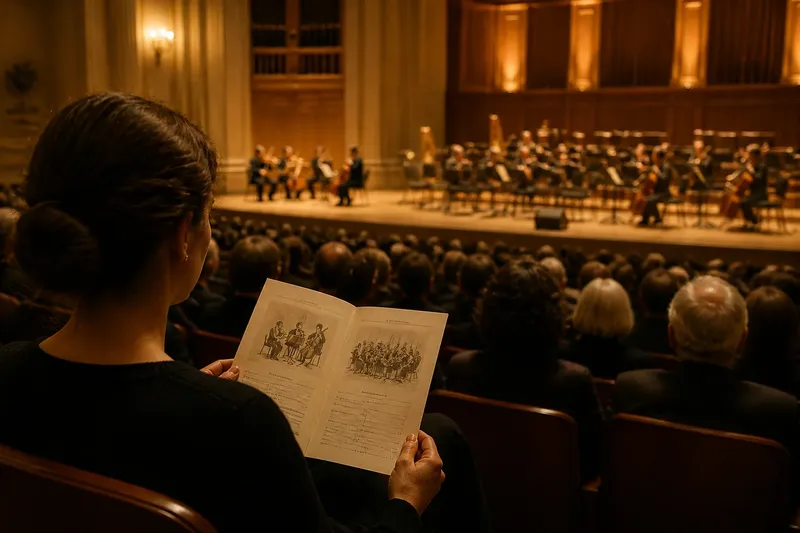
Before the Printed Programme: How Concert Notes Took Shape
Learn how concert notes developed alongside printed programmes, and use a short note to find one listening clue without turning a concert into homework.
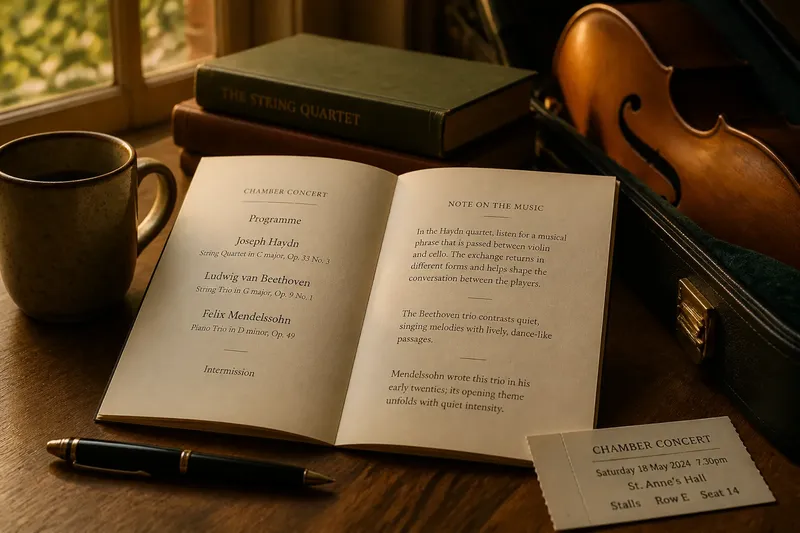
A folded programme lands on your seat, and a few lines about the music give you somewhere to begin. Concert notes now often arrive in print, but there was no single moment when spoken guidance disappeared and a standard note took its place. The change was gradual and varied by venue: written material offered one more way to share context before the first sound.
Concert guidance took different forms in different settings
At some musical gatherings, a host or performer could introduce a piece aloud. Elsewhere, listeners relied on conversation before or after the music, or brought knowledge of the performers and repertoire with them. These are broad possibilities, not a universal account of concert life: customs differed between places and occasions.
Spoken guidance had an immediate, social quality. A listener could hear an explanation in the room, but might not catch it, remember it, or have a chance to revisit it. In a quiet performance, speaking during the music might not suit the event at all. Written context offered a different option, one that could be read privately and returned to later.
Printed programmes made context available to revisit
Concert print did not take one fixed form. A programme might name the works and performers, add a short explanation, or combine musical context with practical information. The contents depended on the event and its organisers; a printed sheet did not necessarily mean a long essay or a detailed account of every piece.
What print made possible was preparation outside the moment of performance. A reader could look over a work’s title beforehand, check an unfamiliar name, or return to a sentence during a pause. Like a labelled drawer, a programme keeps a clue in one place for anyone who wants to find it; unlike a conversation, it cannot respond to a listener’s question.
Written notes changed how listeners could prepare
With context available in writing, a listener could arrive with a few bearings without needing to master the music in advance. A note might point to an exchange between instruments, a change in texture or a detail about the work’s setting. That clue can focus attention, but it does not prescribe what the listener should feel.
There is a balance to strike. A note that assumes too much knowledge can leave a newcomer puzzled; a note that explains every turn may keep the reader’s eyes on the page instead of the performers. A useful note gives a starting point and leaves room for the music to surprise you.
Say you have a ticket to an unfamiliar chamber concert, and the programme includes a short note saying that the players pass a musical phrase between them. You read that sentence at home, then put the programme aside once the music begins. The expected observable result is simple: you have one feature to listen for, while remaining free to follow anything else that catches your attention.
A short routine connects concert notes with listening
Try this routine with a coming concert. At each point, use what you observe to decide whether to read, save or set aside the material.
- Before choosing a note: Check the venue’s programme page for the works, performers and any available notes. If the page identifies a specific piece you do not know, read its note; if it only offers general background, save it for later and begin with the work titles.
- When you open a note: Look for one concrete listening clue, such as an instrument passing a phrase or a contrast between quiet and forceful passages. If the note offers a clear clue, keep that sentence; if it is dense with unfamiliar terms, set it aside and use the programme’s basic details instead.
- Before leaving home: Decide whether you need paper or can open the venue’s page on your phone. If you want to consult notes without handling a screen in the hall, bring the printed programme if available; if not, save the page and read it before the performance.
- When the music begins: Notice whether reading would distract you from listening. If your attention keeps returning to the page, put it away; if you are still waiting for the performance to start, use that time to check a name or title.
- During an interval: Check whether a question about the music is still on your mind. If a note addresses it, read that passage; if the music has held your attention without explanation, leave the programme closed.
- After the performance: Compare the note’s clue with what you remember hearing. If it helped you notice a feature, keep it as a useful prompt; if the performance led you elsewhere, trust that response and leave the note’s suggestion behind.
Imagine you have an invented ticket to a chamber concert, a printed programme and a note about a phrase passed between violin and cello. You read the note at home and decide that the exchange is the only clue you want to carry in. At the hall, the programme is easy to reach, but reading it during the opening music would distract you, so you put it aside; at the interval, you remember hearing the cello answer the violin and decide the note did its job. The trade-off is clear: the writing gave your attention a starting point, while setting it down left you free to hear the rest on your own terms.
Why did spoken guidance give way to printed notes?
Did audiences hear explanations during concerts?
Sometimes a host or performer spoke, while other occasions called for quiet listening or relied on conversation around the event. Practices varied, so spoken introductions were one form of guidance rather than a universal custom.
What could a printed concert programme include?
It could list works and performers, offer a brief note, or combine context with practical details. The format and level of explanation depended on the event and its organisers.
Why can printed notes help a newcomer?
A written note can provide context without requiring a personal introduction or familiarity with local customs. The reader can choose when to consult it and return to a detail later.
Should you read concert notes before the performance?
Reading beforehand can make names or listening clues more familiar, but it is not essential. Read when the notes support your attention; otherwise, leave them for a pause or after the music.
Concert notes remain an invitation to listen
Print did not make spoken guidance or conversation obsolete. It added a portable form of context that audiences could use at their own pace, before, around or after a performance. That distinction is useful when a concert brings together listeners with different levels of familiarity: a concise note can offer a shared starting point without requiring a shared response.
Next time you pick up concert notes, choose one sentence that gives you a useful bearing and let the rest wait. The history of concert notes is not a simple story of one custom replacing another; it is a reminder that written context can be there when you want it, and set aside when the music gives you something better to follow.