Three Lines to Keep After a Concert
Three lines to keep after a concert preserve a vivid sound, a surprise and an open question, so you can revisit the evening without writing a review.
The last chord fades, the hall lights lift, and someone near the aisle asks what you thought. You remember a low note humming through the floor, but the rest of the concert has begun to blur. Three lines to keep after a concert give the evening somewhere to land: one sound, one moment of surprise and one question.
This is not a miniature review or a scorecard. It is a way to save three handles on an experience while it is still fresh. The format is narrow by design; the useful work lies in choosing what to keep, especially when the foyer is noisy or no question comes readily to mind.
Catch a detail before the concert fades
By the time you get home, the music may have become a vague impression: “beautiful”, “intense” or “long”. Listening is not the same as taking notes. A sound can be vivid in the room without arriving as a ready-made sentence, and the walk to the station brings distractions of its own.
Capture a few words as you leave, then shape the full lines later. A phone note or the back of a ticket can hold fragments such as “bowed bass, shiver” or “sudden silence”. You are saving a cue, not composing polished prose.
Keep the three prompts visible: one sound; one surprise; one question. They are like three hooks on a coat rack: each holds a different part of the evening, and none has to carry the whole thing.
Describe one sound rather than listing instruments
An inventory—violins, horn, piano, percussion—may name what was on stage without saying what you heard. A memorable sound is often about texture, movement or where it seemed to sit in the hall.
Describe one audible detail with a verb, a quality or a place. Was a note held until it seemed to fray? Did a soft rhythm patter beneath a louder melody? Did the bass feel close while the upper strings seemed distant? Technical terms are optional. “A dry, ticking rhythm beneath the flute” can be more personal than a list of players.
Choose one detail, even if another sound was equally striking. The line is a doorway back into the memory, not a catalogue of everything that happened.
Find the surprise in a shift of attention
“Surprise” need not mean a dramatic twist. It may be a pause lasting longer than expected, an instrument entering from an unexpected direction or a familiar passage feeling newly tender.
Ask where your attention changed. Perhaps you leaned forward, stopped following the melody or realised the ending had arrived. The surprise can be in your response as much as in the score.
Say you hear a clarinet emerge from a texture you had thought was entirely string-led. You could write, “The clarinet appeared behind the violas; I had stopped listening for wind.” The line records the entrance and your change of attention without judging the player or claiming the whole performance was unexpected.
Shape a question that stays open
A final line such as “Was it good?” closes the memory down. A question aimed at a performer’s choice can also turn into criticism before you have worked out what puzzled you.
Instead, ask something curious that you could revisit by listening, checking the programme or talking it through. Try “What made that pause feel so long?” or “Was the melody doubled by another instrument near the end?” You do not need to solve the question that night.
A useful question points towards something audible: a change in texture, the balance between sections, the shape of an ending or your own shifting attention. It need not be profound to be worth keeping.
What if a detail or question will not come?
What should I do if I cannot name the music?
Write down the sound in plain language and add where it happened, such as “thin high note after the pause”. If the printed programme is to hand, add a work or section name later; the memory does not depend on identifying it immediately.
How do I remember which moment surprised me?
Look for a change in your attention: a sudden stillness, an unexpected entrance or a passage that made you listen differently. Record the cue and your response rather than trying to explain the whole musical structure.
Is this meant to become a concert review?
No. Keep the lines private and provisional if that suits you. They preserve a sound, a shift and an open thought rather than assessing the whole performance for an audience.
What if I have no question at the end?
Write what you would like to hear more clearly next time, even if it is as simple as “Where did the melody go?” An unfinished question is enough if it gives your attention somewhere to return.
Keep the note from becoming a review
Once a pen or notes app is open, it is easy to treat the reflection as a report that must be complete and defensible. Keep each line to a single thought. Avoid ratings, sweeping claims and verdicts about whether the performance succeeded. If another detail arrives, leave it out or save it separately; the three-line note is a memory aid, not a container for every opinion.
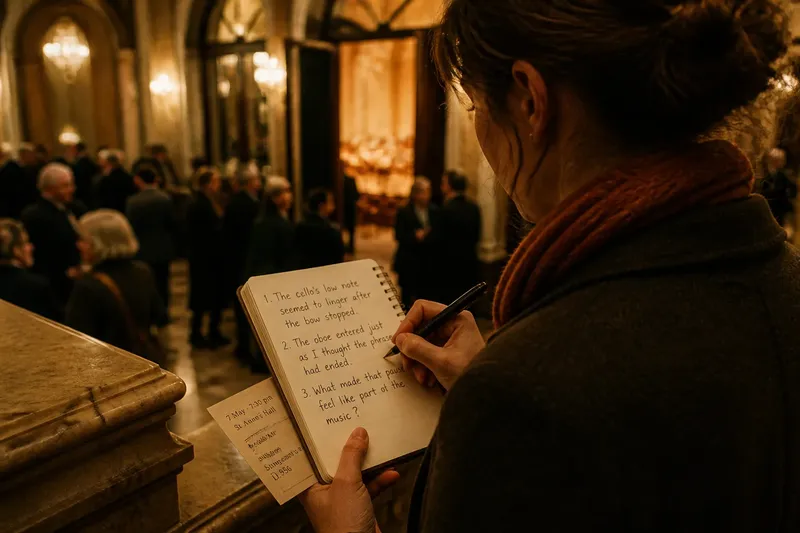
Imagine you leave a chamber concert with a resonant cello note, an entrance that caught you off guard and a question about a pause. Your three lines might read: “The cello’s low note seemed to linger after the bow stopped.” “The oboe entered just as I thought the phrase had ended.” “What made that pause feel like part of the music?” Each line preserves a different thread without pretending to account for the whole concert.
Add a small identifier for your future self
An old entry that says “lovely sound” may become hard to place. A vivid phrase can lose its setting: the venue, piece or section of the evening may vanish from memory before the note itself does.
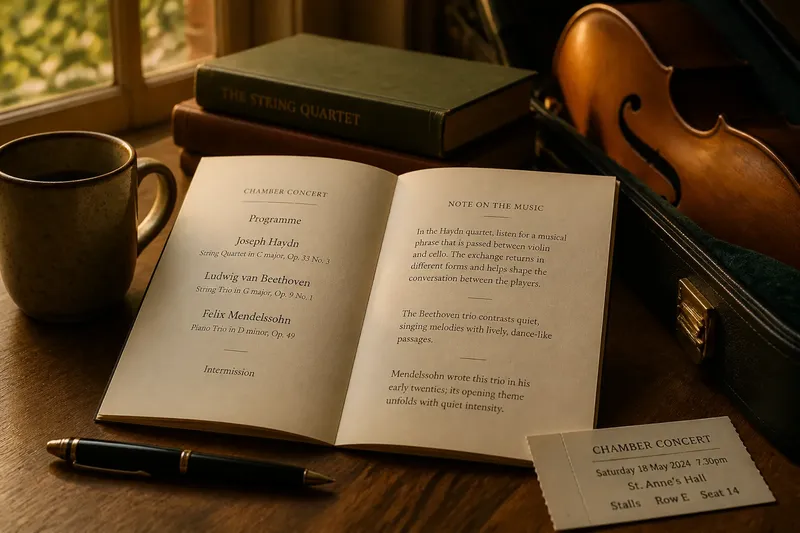
Add a brief identifier outside the three lines: the date, venue and programme item, if you know them. Keep that heading factual and short. Then leave the reflection itself untouched; its uncertain wording may preserve how the music felt before later explanations took over.
Three lines to keep after a concert work best when they stay modest: one sound you can almost hear again, one moment that shifted your attention and one question you are happy to leave open. Write the identifier while the ticket or programme is still nearby; it will help you find the note later without crowding out the memory.